← Back to Trade Talk Blog
Our Trade Talk blog has covered many diverse topics in recent weeks. But today it’s time to squeeze in a few words on new product functionality.
The primary focus of our new TT platform is simple: provide the best trading experience available anywhere. That’s an easy statement to make and sounds really nice, but it typically makes users roll their eyes. Why? Because delivering on that goal is extremely difficult.
But what about me?
As a trading system vendor, we deliver a set of functionality designed to meet the demands of a broad-based set of users, sometimes with very different needs. But there’s a dilemma in that product delivery model because the process of trading—and trading well—is a very personal endeavor. You want trading software that is customized to *your* style, not a bland, generic, cookie-cutter set of windows.
So how do we address that desire for custom-tailored software and be able to deliver it within a practical framework of commonly used functionality? Well, tucked within our new front end is a hidden gem called widget groups. The “secret” code to unlock this feature is easy to remember: “Control. Shift. Drag.” It’s that simple, but the end result is very effective.
Tags: Trade Execution
IDEM, the Italian Derivatives Market of Borsa Italiana, part of London Stock Exchange Group, is enjoying another strong year in terms of volume growth, making it one of the most interesting equity derivatives markets in Europe. Its flagship products—FTSE MIB index futures, mini-futures and options—are enjoying buoyant performance thanks to increasing interest from both sell-side and buy-side investors globally. Massimo Giorgini, Head of Business Development for Equity and Derivatives Markets at Borsa Italiana, took the time to talk with us about recent developments at IDEM.
TT: Let’s take it from the top. Massimo, can you talk a little bit about your line of business?
Massimo: Borsa Italiana has operated the IDEM market since November 1994, so we recently celebrated its 20th anniversary. IDEM is the leading global liquidity pool to access Italian equity derivatives, offering the full suite of Italian equity derivatives, including futures, mini-futures, options, weekly options on the FTSE MIB Index, plus the full range of Italian single stock options and futures—not only on Blue Chip symbols but also on some Mid Cap names. FTSE MIB index futures, mini-futures and options also can be bought and sold in the U.S. in accordance with the terms of the No-Action letters from the CFTC and SEC.
Continue Reading →
Tags: Market Access, Trade Execution
Possibly, but rarely
The majority of financial market participants would agree on the dogma that commodity prices can never be zero or negative. However, it is not always true in the electricity markets. While zero or negative prices aren’t especially common, they do occur. This can create real chaos in many financial calculations. For example, for an asset with a negative price, dividing by the previous price will give an undefined or misleading result if prices are zero or negative.
The electricity market price—just like a price of any other commodity—is driven by the economics of supply and demand, which in turn are determined by several external factors such as climate conditions, seasonal factors or consumption behavior. To better understand the reasons for the negative prices, one needs to look further into the mechanics of the electricity generation process.
Continue Reading →
Tags: Market Access, Trade Execution
Last week the CFTC issued a report detailing the flash crash experienced in the U.S. Treasury cash and futures markets on October 15. The report highlighted the lack of a “smoking gun” culprit as the cause of the sudden and dramatic price swing witnessed in these markets. Instead, it pointed the finger at a culmination of many factors, including downward pressure on yields leading up to the event combined with an economic data release which contradicted the market’s expectations of a rate increase. It also highlighted another phenomenon prevalent in today’s highly automated markets: self trading.
Technology to Blame
According to the CFTC report, nearly 15% of all transactions were “wash trades” during the period in question, meaning the same person—or two people trading the same account—represented both the buyer and seller on a trade. While this is an incredibly high percentage, what is more troubling is the fact that the average daily percentage of self trading on the cash Treasury markets is nearly 6% of all volume according to the agency’s report. Even though wash trading is typically forbidden in futures markets, it is nevertheless a common occurrence as trading systems and strategies grow in complexity and capabilities.
 |
| Source: Nanex |
Many exchanges have built self-match prevention measures into their matching engines, but they are an “opt-in” feature and are largely considered a blunt instrument trying to solve a more nuanced problem. Self-match prevention is also increasingly under the regulatory microscope due to its role in facilitating spoofing: the assumption goes that if a spoofer is really looking to sell, he or she can put a large bid into the market to encourage other buyers to join and then sell through the level he or she was bidding. This has the effect of creating the necessary size into which the trader can sell while relying on the exchange to safely cancel the resting bid when self-match prevention is enabled.
Continue Reading →
Tags: Algos & Spread Trading, Trade Execution
I recently ran across an interesting post on EliteTrader. The author was looking for software capable of charting synthetic spreads with more than two legs such as the bund-bobl-schatz fly or crack spread. I shared my thoughts on the topic in the EliteTrader forum, but I thought the topic was compelling enough to address here on Trade Talk.
As was mentioned on EliteTrader by another member, charting a synthetic spread created from the underlying legs is not as simple as comparing the last traded price of one leg to the others or using one-minute bar data to compute the spread prices. To prevent from “charting a mirage” as the member stated in the post, we have gone out of our way to provide a better spread chart here at TT. We capture all best bid-ask market moves and traded prices, such that we look at one leg’s best bid or ask price when a trade occurs on the other leg’s bid or ask.
The above method creates an excellent synthetic spread chart, and we support up to 10 legs in a spread. The nice thing about TT is once you create the spread for trading, there is no additional work to create the spread chart. You can request the synthetic instrument and add studies and drawing tools just like a regular instrument in the chart.
Our bid-to-bid/ask-to-ask spread charts will calculate a spread price whenever there is a trade on one leg. If the trade occurs on the bid of leg one, then we will look at the bid of the other legs if they are required to sell and the ask if they are required to buy to determine the spread price. This effectively acts as getting edge on one leg with a limit fill, and the other legs going to market to complete the spread.
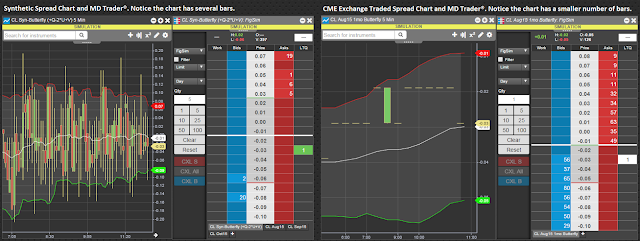 |
Synthetic spread charts (L) will have more data and provide more information
about how a spread moves compared to exchange traded spread charts (R). |
Continue Reading →
Tags: Algos & Spread Trading, Charting, Trade Execution